
The short version
- What changes: only the Ives Hill clubhouse and parking lot (1.7 acres), home to the Bad Apple Social restaurant. The golf course itself stays Residential.
- Why it matters: today the restaurant is legal only because the golf course is open. Rezoned, Bad Apple could run as a standalone restaurant, with or without golf.
- The question to watch Monday: why now? The application doesn't say. A golf course is seasonal and its future isn't guaranteed, so independence from the course would matter in the off-season and if golf ever ends. Expect the owner to explain at the hearing.
- The catch: zoning goes with the land. Mixed-use zoning would also open the door, with permits, to uses like auto repair or a gas station for any future owner. That's why city staff and the Planning Commission didn't back it.
- When: public hearing Mon., Nov. 2, 7:15 p.m., City Hall. Anyone can speak.
On Monday, Nov. 2, Watertown's City Council holds a public hearing at 7:15 p.m. on rezoning a corner of the Ives Hill golf course. The request covers 1.7 acres at Flower Avenue West and Ives Street: the clubhouse, home to the Bad Apple Social at Ives restaurant, and its parking lot. It would change from Residential to Neighborhood Mixed Use.
City planning staff recommended against it, and the Planning Commission voted down a motion to recommend it on Oct. 6. The Council can still approve it. Here's what's at stake, mapped.
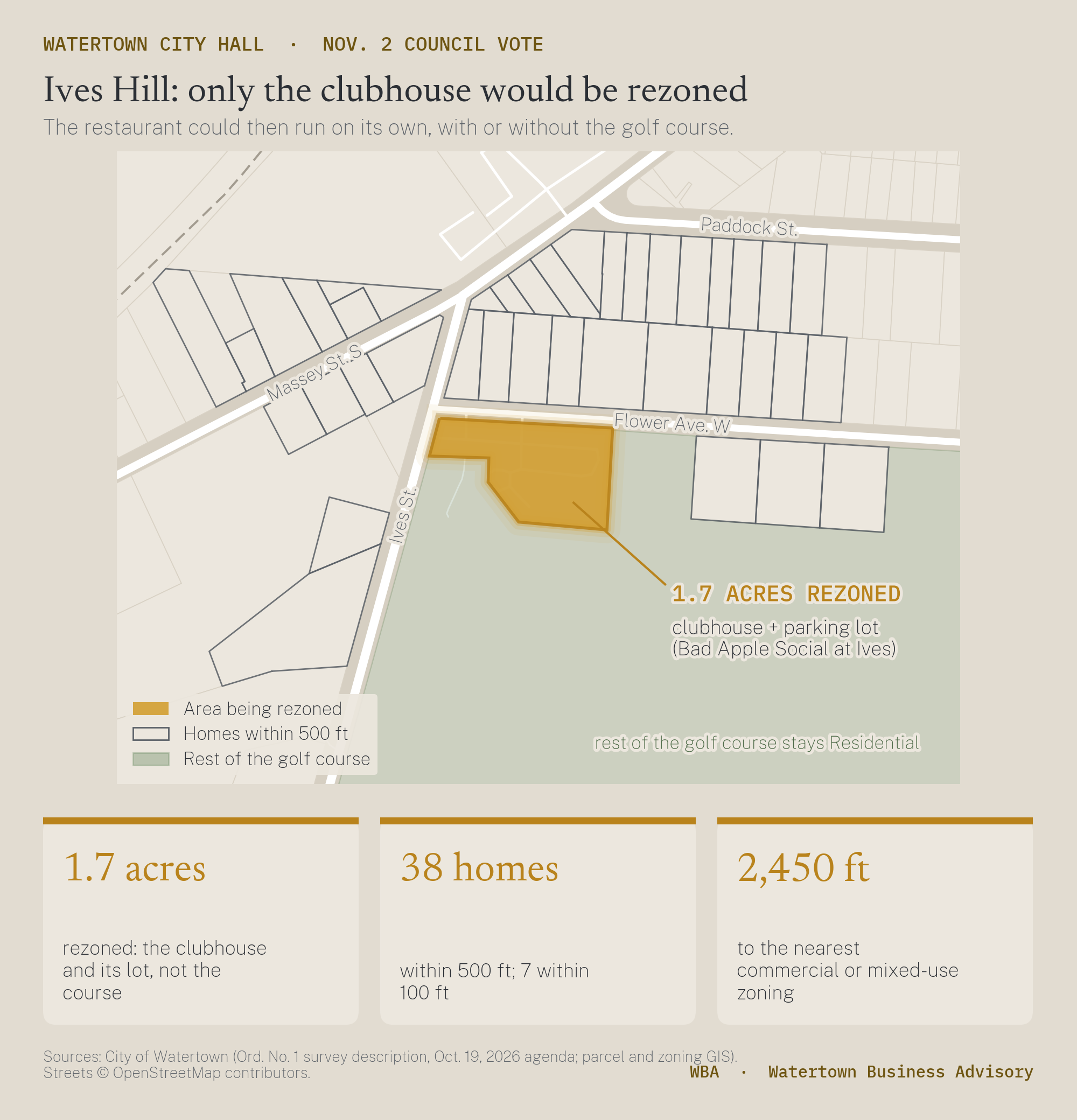
Only the gold area, the clubhouse and its parking lot, would be rezoned. It's drawn from the survey description in the ordinance and measures exactly 1.70 acres. Neighboring homes within 500 feet are outlined; the green tint is the rest of the Ives Hill golf course parcel, which stays Residential. The nearest commercial zoning comes from the city's own zoning map.
The zoning map tells the story at a glance. Everything around the site is zoned Residential, and the city's Comprehensive Plan keeps it that way (future land use: Residential). The nearest land already zoned commercial or mixed-use is about 2,450 feet away, nearly half a mile, north of the rail corridor. If approved, this would be a small mixed-use island inside a residential neighborhood. That's the picture behind city staff's spot-zoning concern.
What's being asked
Ives Hill Country Club 465, LLC wants the clubhouse and parking lot rezoned. Today the restaurant is legal only as an accessory use of the golf course: Residential zoning allows golf courses but not restaurants. If the land is rezoned, the restaurant becomes a use by right, able to operate whether or not the golf course does.
The owner has told city staff it then plans to split the clubhouse and lot off as a separate parcel, so the land isn't zoned two ways at once. The rest of the course, six of its nine holes plus the putting green, would stay Residential.
Not to be confused with Thompson Park: the city-owned golf course that drew a single lease proposal this month is a different course. Ives Hill is privately owned.
Who's nearby
Within 500 feet of the area there are 43 parcels, and 38 of them are homes:
| Distance from the rezoning area | Homes |
|---|---|
| Within 100 ft | 7 (including the five directly across Flower Ave. W, about 45 feet away) |
| Within 250 ft | 14 |
| Within 500 ft | 38 |
The other five are two school parcels, including the former St. Patrick's school land across Ives Street, and three vacant residential lots.
What Neighborhood Mixed Use would allow
This is the heart of the staff report. The rezoning is requested for a restaurant, but zoning goes with the land, not the current tenant. Neighborhood Mixed Use allows, among other things:
- Food and drink: bar, restaurant, café, brewpub; micro brewery, distillery or winery.
- Automotive: auto repair, car washes, fuel and convenience stations.
- More intense housing, retail and office uses than the Residential district allows.
Not all of these are automatic. Under the city's zoning code, some uses in Neighborhood Mixed Use, such as offices and auto repair, need a Special Use Permit, which means a Planning Commission public hearing and conditions the Commission can attach. A restaurant, per city staff, would be allowed outright. So a future gas station or repair shop wouldn't be automatic, but it would be a much shorter step than it is under Residential zoning, where those uses aren't allowed at all.
What it could mean, for and against
If the Council approves it
| Who | Possible upside | Possible downside |
|---|---|---|
| The restaurant and owner | Bad Apple Social no longer depends on the golf course staying open. A separate parcel can be financed, sold or improved on its own. | A ZBA variance and subdivision approval are still required, and a rezoning that breaks with the Comprehensive Plan can be challenged as spot zoning. |
| Neighbors (38 homes within 500 ft) | A neighborhood restaurant stays, even if golf goes. | A commercial zone 45 feet from five homes. A future owner could seek more intense uses: food and drink outright, auto uses with a permit. More traffic, parking or late hours are possible, depending on what operates there. |
| The city | Keeps an operating business, and its jobs and tax base, on the tax roll. | Precedent: the first commercial zoning inside an area the Comprehensive Plan calls low-density residential, which makes the next request harder to refuse. |
If the Council turns it down
Nothing changes today: the restaurant keeps operating as part of the golf course. The difference shows up only if the golf course ever closes, when the restaurant would lose its legal footing too.
The question underneath: what if the golf course closes?
This is what the request is really about, and it's worth spelling out:
| If the golf course closed... | Without the rezoning | With the rezoning |
|---|---|---|
| The clubhouse and parking lot (1.7 acres) | The restaurant could no longer operate: it's legal only as part of the golf course. The land would be limited to homes and other Residential uses. | The restaurant, or another Neighborhood Mixed Use business, could keep operating. |
| The rest of the parcel (36.7 acres) | Stays Residential. Single- and two-family homes are allowed, subject to subdivision approval. | Same: stays Residential. |
Nobody has said the course is closing. But it's the scenario the zoning has to plan for, because zoning outlives owners and tenants.
Why city staff recommended against it
The Planning Department's staff report (Oct. 1) gave three reasons:
- It conflicts with the city's Comprehensive Plan, which maps this whole area as Residential Low Density: "single and two-family homes... ample greenery."
- Spot zoning. Staff pointed the Commission to the state's guidance that rezoning one parcel to a use different from its surroundings, "usually to benefit a single owner," can be illegal unless it is part of a comprehensive plan serving the whole community.
- The new lot wouldn't fit the rules. New lots in a Neighborhood Mixed Use district can be at most 100 feet wide. The clubhouse parcel would be over 400 feet wide along Flower Ave. W, so the owner would first need a variance from the Zoning Board of Appeals before the city could approve the subdivision.
What happens next
- Mon., Nov. 2, 7:15 p.m.: public hearing at City Hall, 245 Washington St. Anyone can speak. It's streamed on the city's Rumble channel.
- The Council also decides on the environmental review (SEQRA) and can then vote on the ordinance.
- If it passes, a Zoning Board of Appeals variance and subdivision approval would still be needed to create the separate parcel.
We'll report what the Council decides, with the moments that mattered from the meeting video, the day after.
Sources
- Oct. 19 City Council agenda: Ordinance No. 1, the Planning Department memo and staff report, and the survey description.
- Public hearing notice
- Parcels: City of Watertown GIS. Distances measured by WBA from the boundary of the rezoning area.
WBA doesn't take a position on zoning requests. This is a plain-English summary of the city's own documents; the city's record is official.